Find Brampton commercial cleaning and sanitation professionals who align with CSA, WHMIS, and Peel Public Health. You'll receive SOPs, SDS access, detailed tracking, accurate solution measurements, and timestamped proofs. We verify disinfection with ATP/fluorescence, ensure dwell times, and utilize ECOLOGO/Green Seal, DIN/EPA-registered chemistries. Staff functions off-peak with security protocols, color-coded tools, and documented handling for disinfectants. Auditable reports, CAPA workflows, and specialized protocols (office, retail, healthcare, industrial) come standard. See how we reduce disruption while improving standards.
Main Insights
- Comprehensive SOPs following CSA, WHMIS, and Peel Public Health guidelines with audit-ready documentation featuring complete SDS libraries, lot tracking systems, and time-verified service documentation.
- Risk-based sanitation protocol: featuring comprehensive touchpoint mapping, EPA-registered cleaning solutions, verified contact times, ATP and fluorescence testing, and periodic third-party microbial swab assessment.
- Operational precision: implementing non-peak timing, micro-crews, security protocols, documented handling for chemicals, and controlled distribution with service records.
- Environmental responsibility: Green Seal/ECOLOGO certified solutions, automated dilution technology, innovative microfiber solutions, detailed waste assessments, and ISO 14001-compliant sustainability KPIs.
- Comprehensive QA processes including oversight checks, corrective action procedures, training documentation, and conformity records customized for Brampton bylaws, insurance requirements, and regulatory standards.
Professional Cleaning: A Critical Need for Brampton Businesses
Although routine tidying maintains surface appearances, expert cleaning validates your Brampton facility complies with regulatory, safety, and health standards. It's essential to have documented procedures conforming to local regulations, approved chemistries, and precision-tuned equipment to mitigate liability and contamination concerns. Trained professionals implement established cleaning protocols, color-coded equipment, and specific timing protocols to guarantee effective pathogen elimination and surface clearing without compromising surface integrity.
You'll gain value through risk assessments that map foot traffic, contact areas, and ventilation effects, then establish specific intervals and quality assurance protocols. Weather-related aspects are important: cold weather necessitates entryway scrubbing and mat maintenance; warm season moisture needs humidity management and mold mitigation; autumn and spring seasons carry airborne particles requiring enhanced filtration and high-dusting. Comprehensive documentation, chemical information availability, and waste management systems facilitate reviews and verify regulatory compliance.
Business Segments: Offices, Retail, Healthcare, and Industrial
You need cleaning standards that align with commercial space needs-high-contact surface sanitization, flooring maintenance schedules, and refuse sorting-while following local health and safety bylaws. For healthcare, you require CSA- and IPAC-compliant procedures, EPA-registered disinfectants, confirmed product application periods, and chain-of-custody documentation for biohazard handling. In industrial settings, it's necessary to maintain WHMIS/GHS labeling, lockout/tagout coordination, particulate filtration systems, and inspection-ready protocols.
Business and Retail Guidelines
As operations extend over multiple locations including offices, retail spaces, healthcare centers, and industrial facilities, cleaning standards must conform to regulatory requirements and documented quality measures. For office and retail environments, you must establish cleaning schedules, procedures, and validation processes by area. Use layout planning to map high-traffic areas, contact points, and surface requirements, before arranging tasks based on risk categories. Specify appropriate cleaning agents, mixing proportions, and contact duration; document SDS access and dispenser calibration.
Establish staff guidelines for: zone-specific glove protocols, wire control, noise-reduction practices, and safety signage for fall protection. Implement a color-based organization for equipment to prevent contamination between areas in different facility sections. Plan systematic vacuum maintenance, microfiber system updates, and waste management. Assess outcomes using ATP testing, maintenance records, and remediation processes based on performance metrics and client service agreements.
Medical and Industrial Compliance Standards
Because of healthcare and industrial click here settings maintain higher risk profiles, we put in place proven processes that align with regulations and endure audit scrutiny. You obtain site-specific Standard Operating Procedures compliant with CSA, Public Health Ontario, and OSHA/WHMIS standards. We use color-coded tools, closed-loop chemical dilution, and barcode-logged procedures to ensure trackability, infection control, and contamination prevention.
In our clinical settings, we adhere to Spaulding classifications, perform terminal cleaning, and utilize EPA-registered disinfectants with verified wet contact times. We confirm effectiveness through bioluminescence monitoring and comprehensive audit checklists. Sharps disposal areas maintain puncture-resistant waste handling and detailed chain-of-custody tracking.
Within industrial zones, we manage LOTO coordination, dust hazard mitigation, and non-sparking tool implementation. Floors undergo thorough degreasing with slip resistance verification. We maintain instrument accuracy, manage SDS documentation, conduct hazard communication education, and produce compliance records meeting your audit protocols and insurance specifications.
Advanced Disinfection Protocols for High-Traffic Zones
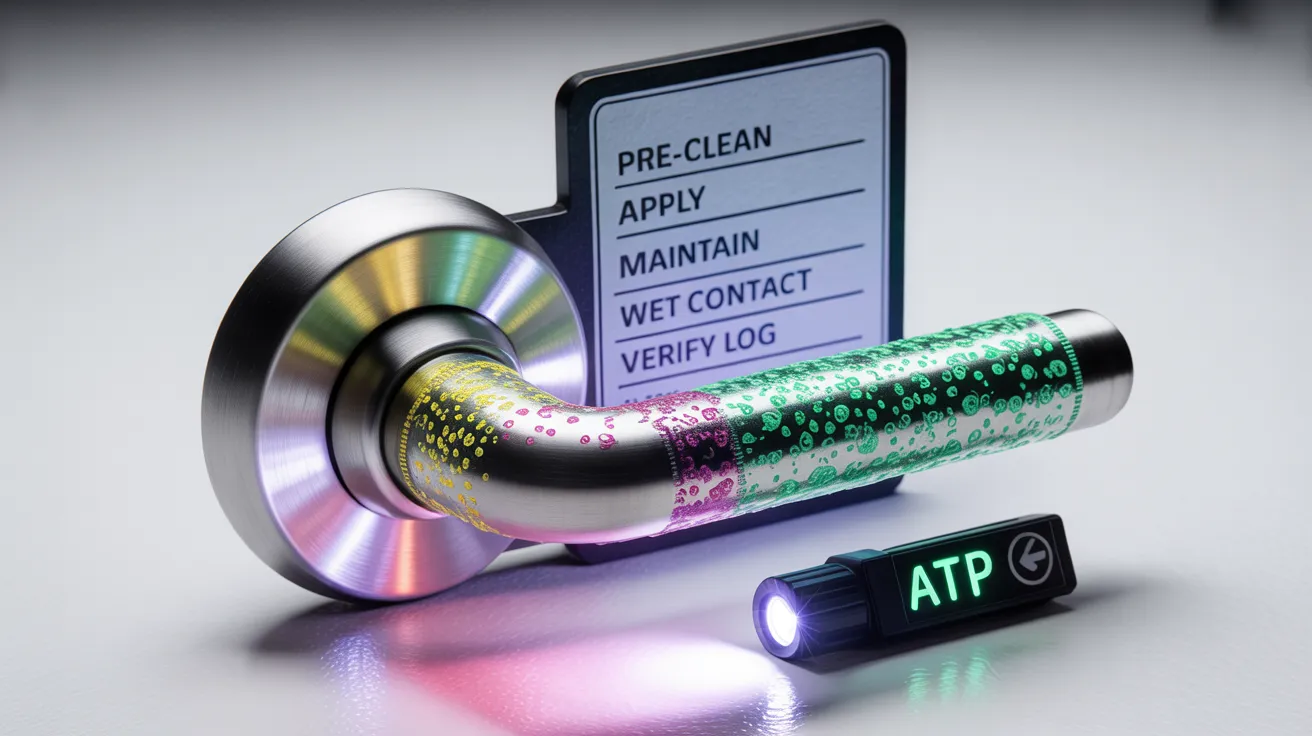
While standard cleaning eliminates visible soil, enhanced disinfection protocols target microbial colonies on high-touch surfaces with verified, measurable methods. You'll start with touchpoint identification to catalog shared equipment, door fixtures, handrails, light switches, faucets, elevator controls, and payment terminals. Determine risk tiers, specify dwell times per EPA-registered disinfectant, and note material compatibility to avoid surface deterioration. Standardize sequence: clean first, apply product, ensure proper contact time, and confirm.
Apply electrostatic distribution for complex geometries and uniform wrap-around coverage; adjust dispensers, validate droplet size, and monitor pass speed. Conduct ATP testing or fluorescence markers for instant quality confirmation, and arrange periodic external laboratory testing for results verification. Instruct staff on proper PPE procedures, safety information analysis, and lot tracking. Document batch numbers, chronological data, and staff identifiers for compliance preparation and incident traceability.
Eco-Friendly Products and Sustainable Practices
You'll choose eco-friendly cleaning agents that meet ECOLOGO or Green Seal certifications and adhere to WHMIS and SDS protocols. You'll implement waste minimization approaches, incorporating microfiber technology, dilution control, reusable dispenser options, and source-separated recycling according to Brampton and Ontario requirements. You'll verify performance with VOC restrictions, biodegradability standards, and periodic audits to track compliance and sustained improvement.
Environmentally-Certified Cleaning Agents
Set a more rigorous compliance bar by mandating eco-certified cleaning solutions that meet recognized standards such as ECOLOGO (UL 2792/2795), Green Seal (GS-37/GS-53), or EPA Safer Choice. In your green certification overview, list the item name, certification ID, dilution ratios, pH range, VOC content, and SDS references. Require third-party verification on containers and verify listings in each certification authority's online registry.
Identify cleaning solutions compatible with microfiber applications, automatic scrubbers, and contact point procedures. Choose surface-active compounds with fast decomposition, NPE-free formulas, and reduced water toxicity levels. Determine residue limits to support allergen minimization on high-traffic surfaces and in indoor air quality-critical spaces. Implement closed-loop dispensing to avoid excess use and maintain ppm accuracy. Educate personnel on application periods for cleaning substitutes conforming to Safer Choice's partner criteria. Audit quarterly, analyze residual compounds, and document variances with remedial measures.
Effective Waste Management Approaches
While maintaining stringent hygiene standards, establish waste reduction by setting up recyclable and refillable systems across sites. Begin by conducting Waste audits to quantify material streams by mass, contamination metrics, and waste costs per department. Utilize data to choose long-lasting dispensers, bulk chemicals, microfiber solutions with tracked laundering and color-designated containers. Enforce vendor take-back for packaging materials and pallet reclamation.
Implement organic waste management systems for food waste from kitchens and break areas, confirming that disposal liners conform to ASTM D6400 and haulers approve their use. Optimize pickup schedules according to bin fill-level data to avoid capacity problems and pest infestations. Provide staff training with operational guidelines, informational displays, and regular training sessions. Track key performance indicators: waste diversion rates, per-person waste generation, and incident nonconformities. Document processes to satisfy city requirements and ISO 14001 criteria.
Strategic Scheduling for Minimal Disruption
To ensure operational continuity, adaptable timing allows cleaning is conducted outside high-traffic times to prevent business interruptions and profit impact. You determine specific service windows, backed with after-hours coordination, so teams operate when facility usage is minimal. We analyze your operating calendar, exclusion windows, and mandated closures, then coordinate work procedures to avoid conflicts with shipments, inspections, and upkeep.
To optimize operational efficiency, we implement rotating crews and dedicated units with detailed role-specific protocols, scheduled workflows, and quality standards. Staff members strictly follow environmental and sensory limitations, and work with rapid-cure solutions to minimize waiting periods. Security protocols, key tracking, and record-keeping processes maintain oversight. We systematically track service details, exception handling, and occurrence tracking to fulfill operational guidelines, industry protocols, and municipal requirements while maintaining productivity.
Deep Cleaning vs. Regular Maintenance: What to Know
Because operational risk and compliance requirements differ by task, you need a clear separation between routine maintenance (regular cleaning to sustain hygiene standards) and deep cleaning (scheduled thorough remediation that restores challenging and high-risk zones). You'll assign daily upkeep to high-touch surfaces, washrooms, floors, and communal equipment using approved cleaning agents, microfiber cleaning materials, and contact-time certified disinfectants. You must record schedules, PPE, procedures, and pass/fail outcomes.
Establish deep cleaning for regular upkeep guided by hazard mapping: critical areas including ceilings, HVAC systems, grout lines, equipment spaces, drains, and porous surfaces. Apply bioluminescence or UV markers to confirm before and after outcomes, escalate to HEPA filtration, scale removers, and steam cleaning where biofilm formation is likely. Define SOPs, color-coding, and tool segregation to prevent cross-contamination. Record findings, corrective actions, and reinspection intervals to preserve cleanliness.
Compliance With Health and Safety Standards
Your facility maintenance strategy will only work if it aligns with statutory and industry requirements, so anchor every task to specific standards and maintain proof of conformity. Align each surface, chemical, and method to industry standards and regulatory requirements. Update SDS libraries, dilution logs, lot tracking, and equipment calibration documentation. Educate staff on PPE selection, donning/doffing, and exposure response. Establish color-coded tools and closed-loop chemical systems to eliminate cross-contamination. Plan internal audits, keep checklists, photos, and corrective actions to maintain inspection readiness. Track regulatory updates from Peel Public Health and provincial authorities; update SOPs, signage, and risk assessments accordingly. Validate disinfectant contact times with ATP testing and document results. Manage access to storage, label secondary containers, and conduct ventilation checks with documented maintenance.
Expert Services for Post-Event and High-Volume Situations
Even with tight cleaning windows during high-traffic times, you require swift, standards-compliant remediation that ensures cleanliness levels without impacting daily operations. We provide strategic mass-gathering cleanup methods that efficiently divide areas, evaluate soil conditions, and deploy rapid-cure solutions tested according to ASTM and Health Canada guidelines. We perform comprehensive sanitization of frequently touched areas like rails, seats, and concessions with DIN-registered solutions with documented contact times.
In floor maintenance, we utilize slip-resistance-preserving detergents, machine clean paths, and microfiber cleaning processes to reduce re-soiling. We separate waste materials per municipal bylaw, with sharp objects, glass items, and organic matter handled via designated containers and documentation. After-event odor management employs source removal, biological treatments, and MERV 13-18 air filtration to restore IAQ benchmarks. Washroom servicing include scale elimination, grout disinfection, and replenishment aligned to occupancy projections.
Expert Personnel and Quality Control Standards
Those event-scale protocols are only effective when certified professionals carry out them under a formalized QA framework. You depend on certified professionals who comply with SOPs aligned with CSA, WHMIS, and manufacturer guidelines. Each specialist undergoes fundamental and periodic skill verification on chemical interaction, dwell times, microfiber sequencing, and ATP verification. You require chain-of-custody logs for disinfectants, calibrated meters, and color-coded zone controls to eliminate cross-contamination.
The quality assurance process operates in a closed-loop system. Supervisors conduct performance audits using detailed checklists, monitoring critical contact points with ATP analysis and visual assessments. Compliance gaps generate remedial responses, detailed issue analysis, and competency development. Proof of service delivery receives temporal validation, with photo documentation stored in compliance records for pattern evaluation and assessment. Quarterly drills, safety gear fitting assessments, and skill enhancement programs maintain measurable and up-to-date competencies.
How to Choose the Right Cleaning Partner in Brampton
When selecting a Brampton cleaning company, consider more than cost and examine verifiable compliance, staffing practices, and operational controls. Validate workers' compensation insurance and liability protection levels, along with professional accreditations (such as ISSA, GBAC). Ask for standard operating procedures, chemical documentation with SDS, and equipment maintenance records. Ensure background verification, vaccine protocols where required, and appropriate supervision levels. Confirm formal instruction on WHMIS, exposure control procedures, and local regulations, covering waste management and medical waste management.
Review quality assurance frameworks including scheduled inspections, environmental monitoring protocols, and CAPA workflows with timestamped improvement measures. Require performance metrics (response times, quality incidents) and problem resolution procedures. Match specifications with budget considerations through defined intervals, task lists, and operational standards. Confirm eco-friendly documentation and air handling requirements. Insist on backup procedures for health incidents, inventory gaps, and building entry management.
Common Questions and Answers
Understanding Contract Lengths and Cancellation Terms for Cleaning Services
Most cleaning service contracts commonly run on flexible monthly or fixed 6 to 12-month durations. These contracts include details about scope, KPIs, renewal options, and rate changes. Termination provisions generally allow for one to two months' notice for standard cancellation, while instant contract cancellation is permitted for critical problems including safety violations, expired insurance, or service failures. Early termination typically involves penalty fees. Verify that communication requirements (mail or email), cure periods (five to fifteen days), and payment reconciliation are properly outlined to ensure proper adherence.
Can I Get Emergency Spill or Biohazard Cleanup Outside Regular Hours?
Absolutely - we provide after hours services for biohazard and spill emergencies. Just like an emergency signal breaking through darkness, you'll get a quick response unit within 60-90 minutes. Our team comes in protective equipment, establish biohazard containment, secure HVAC if required, and follow OSHA, WHMIS, and local public health protocols. We maintain chain-of-custody for waste, perform ATP verification, and deliver incident reports. Just give phone authorization; we respond right away and charge emergency response fees.
What Security Measures Are in Place for Staff Working On-Site?
We provide thoroughly vetted through a comprehensive screening procedure. We perform comprehensive national and local criminal checks, verify identity, and confirm right-to-work status. We require two professional references while we confirm employment history and professional track record. Drug testing is conducted as specified by client SOPs. Everyone must finish required safety training, WHMIS/OSHA compliance, bloodborne pathogens education, and site-specific instruction. We ensure annual background re-checks for all personnel. All technicians carry general liability, pollution, and workers' compensation protection; documentation and endorsements can be provided upon request.
How Do Services Interface With Building Security and Access Systems?
Yes. You can align operations with your building's access management and security measures through established integration procedures and comprehensive credential management. You'll implement temporary access cards, access-level authorizations, and geographic access limits. We'll facilitate API or OSDP integrations, log synchronization, and visitor access protocols. You'll enforce multi-factor authentication, minimal access rights policies, and background-verified user provisioning. We'll establish operational protocols, security incident handling, and instantly terminate access upon scope changes. You'll get compliance reports and security deviation notifications.
What Reporting Tools and Dashboards Monitor Cleaning Tasks and Service Quality?
A comprehensive KPIs dashboard and mobile logging system delivers detailed, dependable compliance oversight. The platform shows live status information, including check-in times, location data and SLA performance metrics. Users can easily filter reports based on location, time period, and personnel and export comprehensive reports. The system allows verification of supply consumption and adherence monitoring. Data protection is guaranteed with user-specific permissions and robust security protocols, while system interfaces allow thorough operational insights.
Final Thoughts
You're not simply employing cleaning staff-you're investing in a precision tune-up for your building's wellness. With precision sanitization for high-touch zones, environmentally approved solutions, and inspection-ready records, you'll maintain requirements consistently. Flexible scheduling keeps operations humming, while after-event cleanup support remove gathering traces. Trained techs, systematic procedures, and quality assurance checks guarantee uniformity. Select a Brampton partner that validates conformity, verifies performance, and scales with you-so your space operates like a professional environment, hygienic, protected, and regulation-compliant.